Our own product: a home-affordability decision engine
SyntheFi
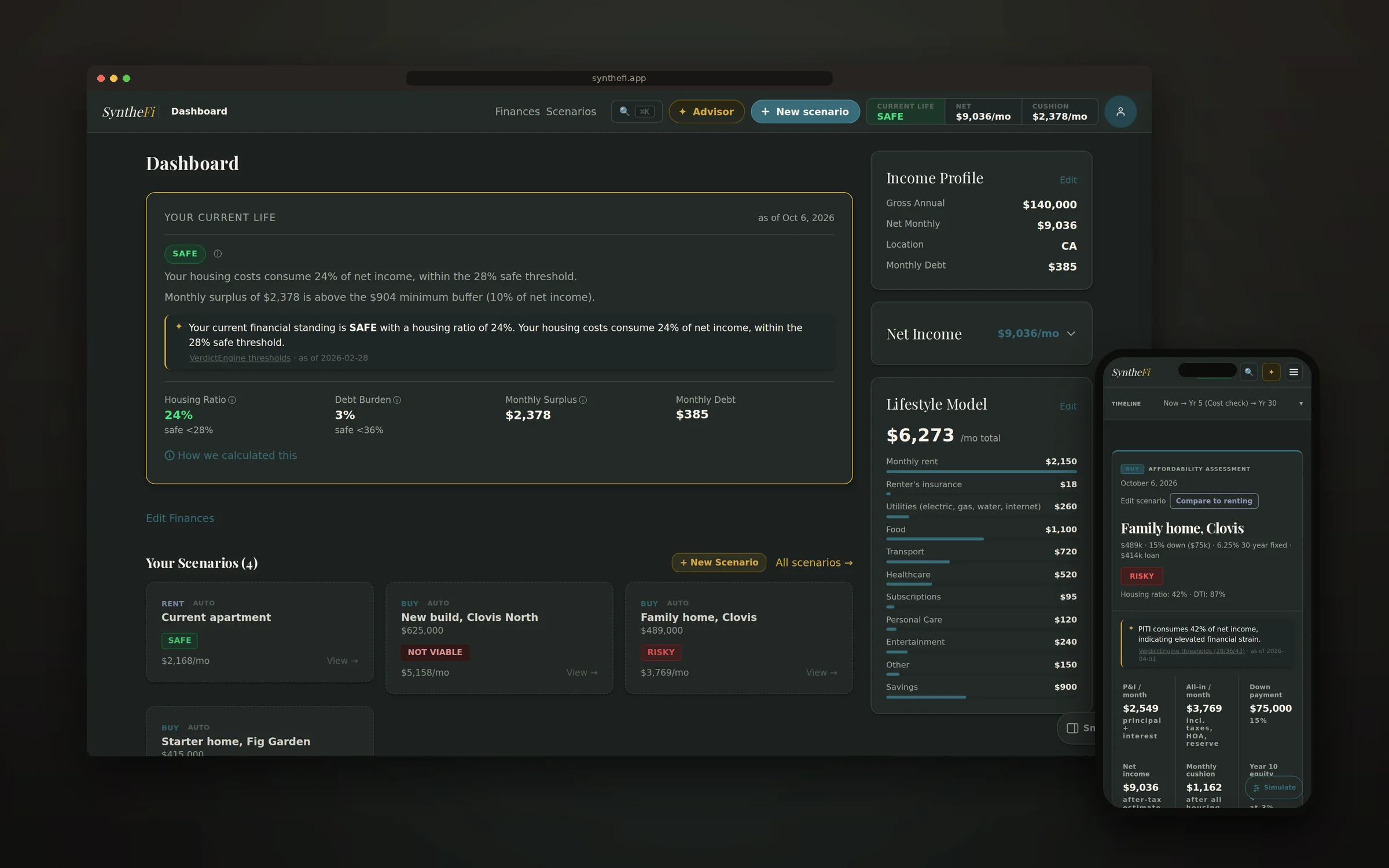
A decision engine for first-time home buyers that answers one question with real numbers: can I actually afford this home, after taxes and the life I already live? And if not, what would have to change?
What the project needed to do.
Lenders approve buyers on gross income. Buyers live on take-home pay, with car payments, childcare and groceries that never show up in an approval letter, and with repair bills and rising property taxes that arrive after closing. SyntheFi closes that gap.
It works out what a household really takes home, what its life already costs where it lives, and what a specific home will cost all-in over time. Then it gives a plain verdict, explains every number behind it, and shows the realistic paths to a safer one.
Capabilities. The features that do the work, in plain terms.
A clear verdict on any home
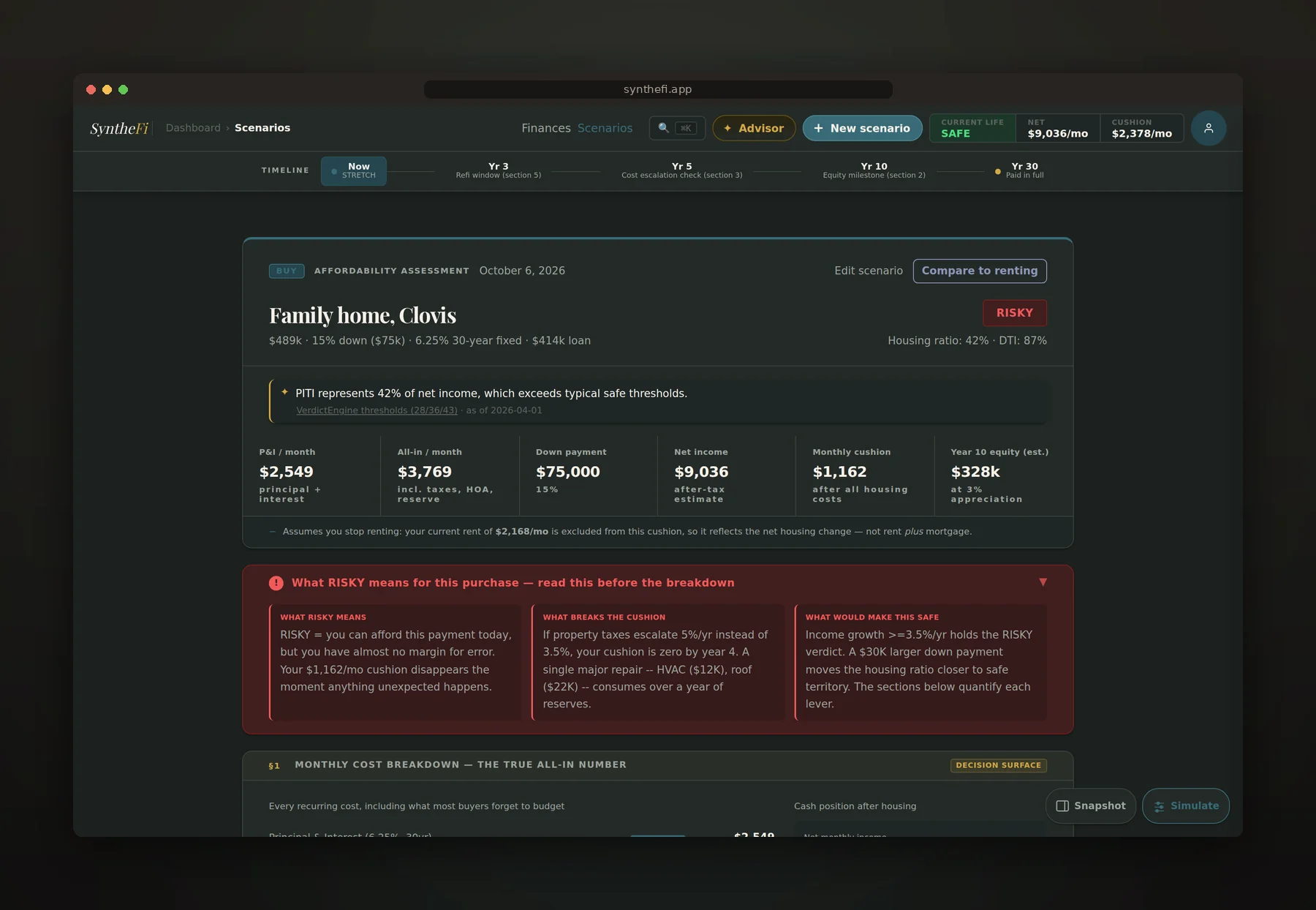
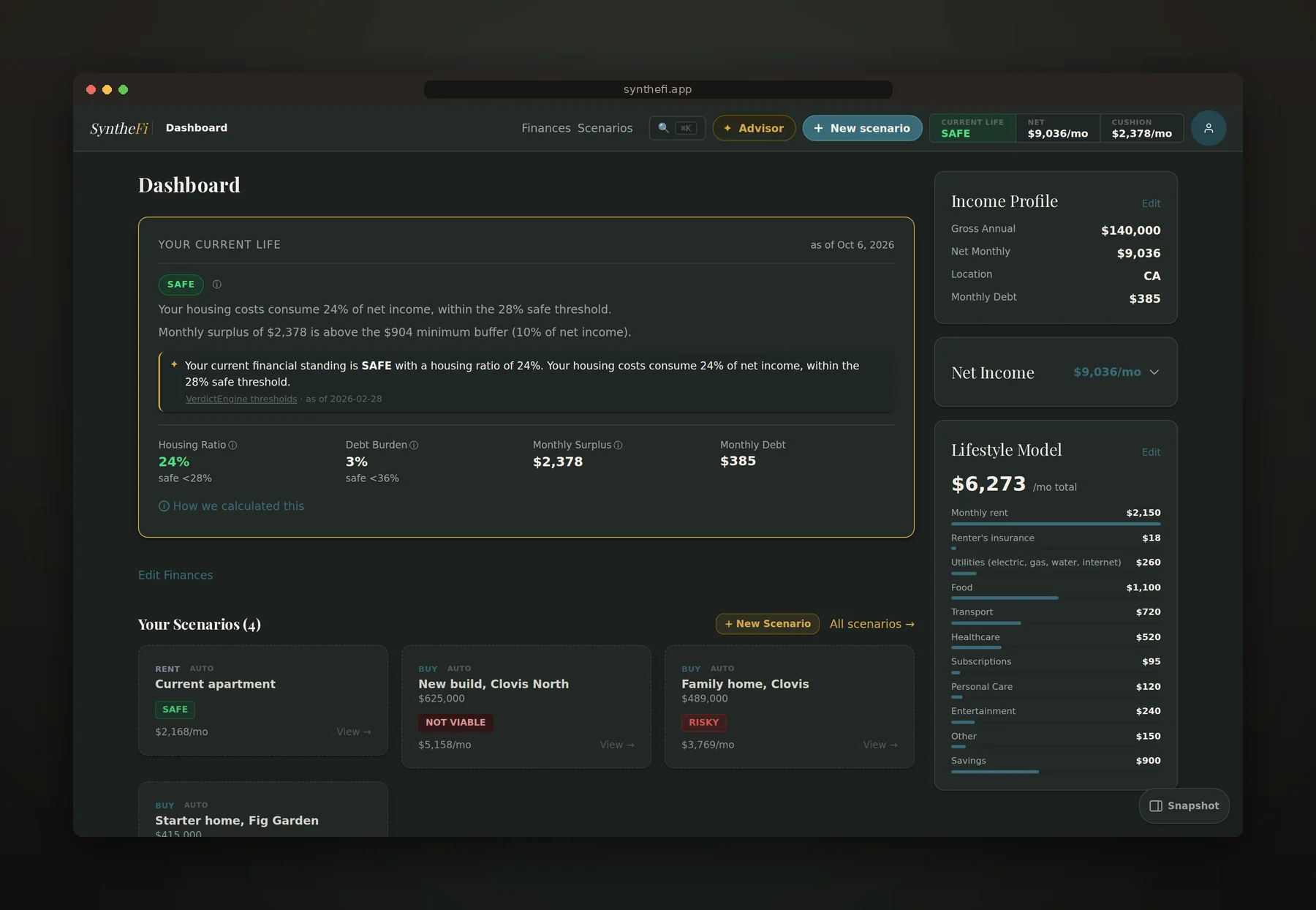
Safe, Stretch, Risky or Not Viable, based on published lending thresholds for housing cost, total debt and the money left over each month. Every verdict explains itself and what would move it.
Real take-home pay
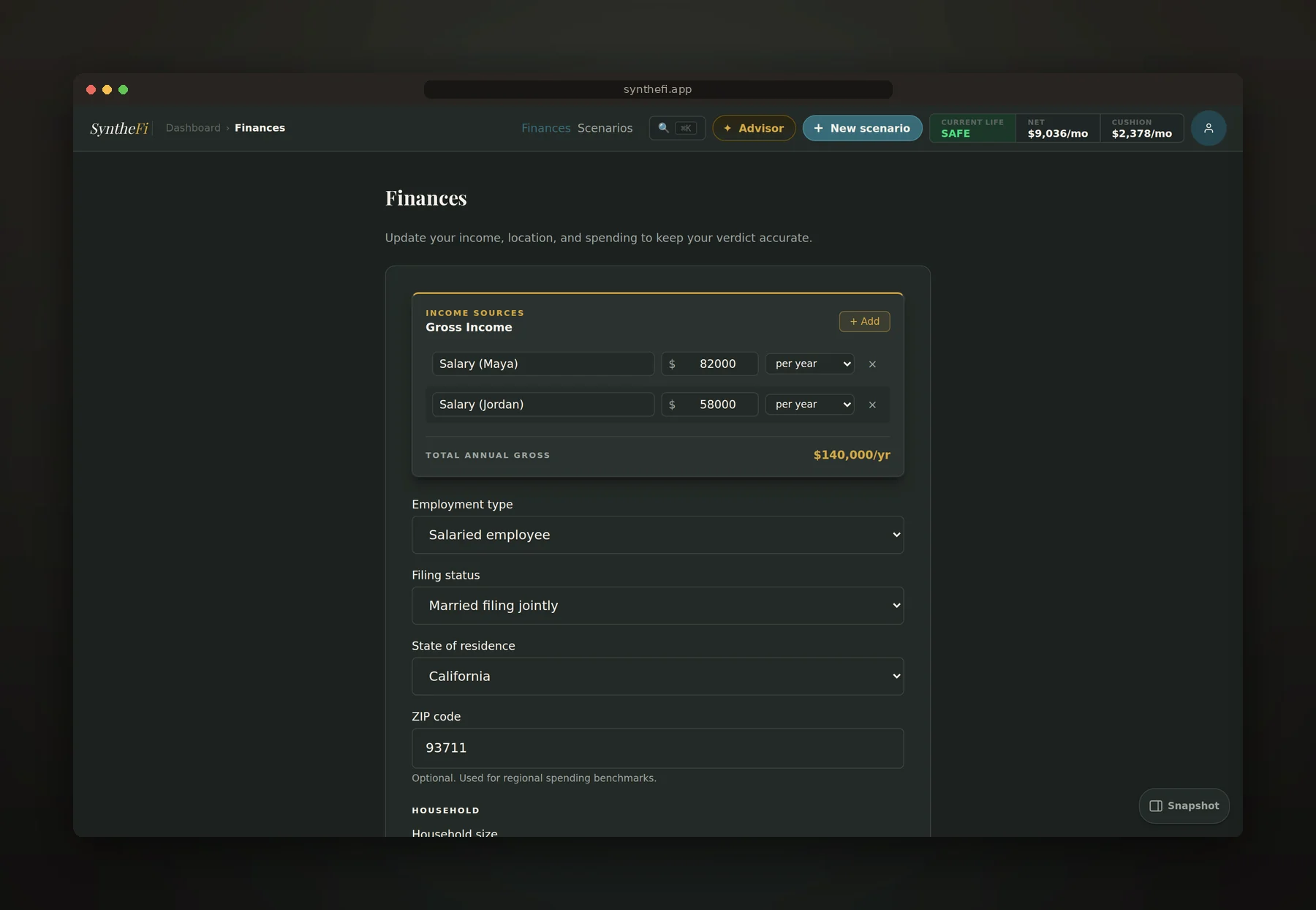
Federal and state income tax, Social Security, Medicare and state payroll taxes are worked out from current tax brackets and filing status, so every verdict starts from money that actually arrives.
Spending and costs for where you live
Spending is pre-filled from federal consumer spending data, adjusted for income, household size and region, and checked by ZIP code, falling back to county, metro and state. Unusual entries are flagged.
Tradeoff simulator
Lock what's fixed, slide income, spending and market conditions, and watch the verdict update instantly. It ranks five ready-made paths to a safer verdict by what each one asks of you, from trimming spending to negotiating price.
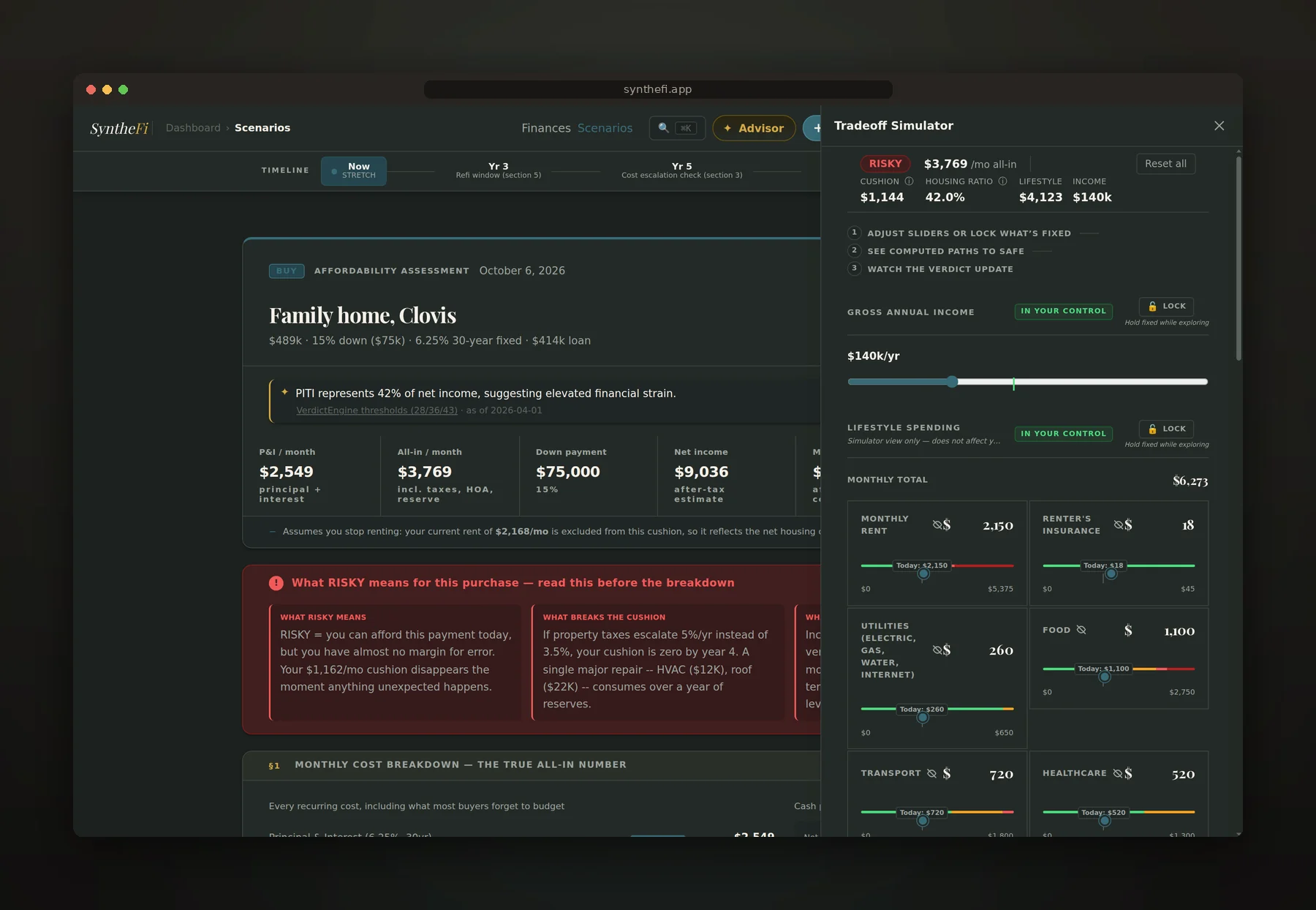
Rent versus buy
Projects wealth year by year for owning against renting and investing the difference, with editable assumptions, break-even rent, and the rent at which both paths end up equal.
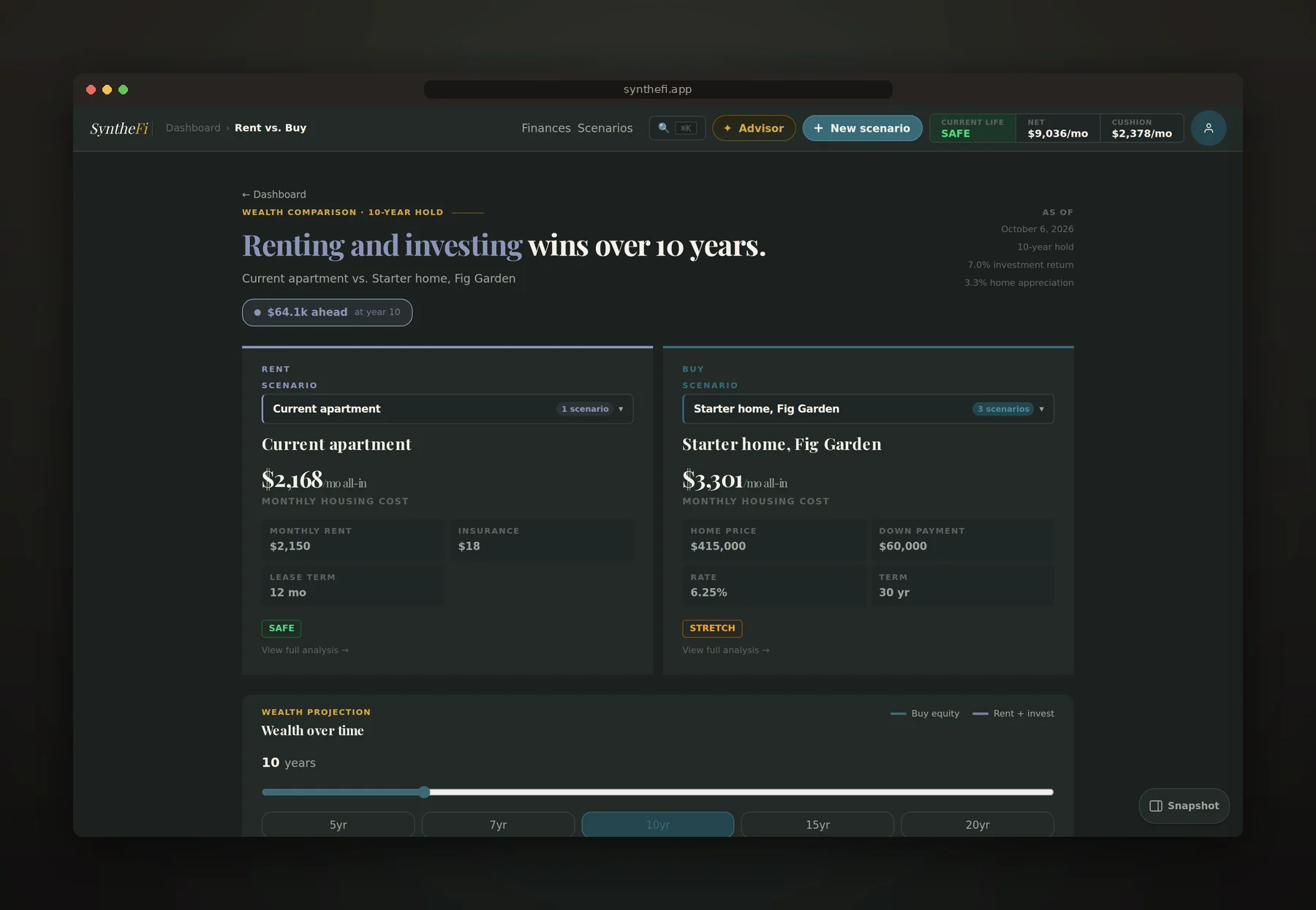
Rent scenarios
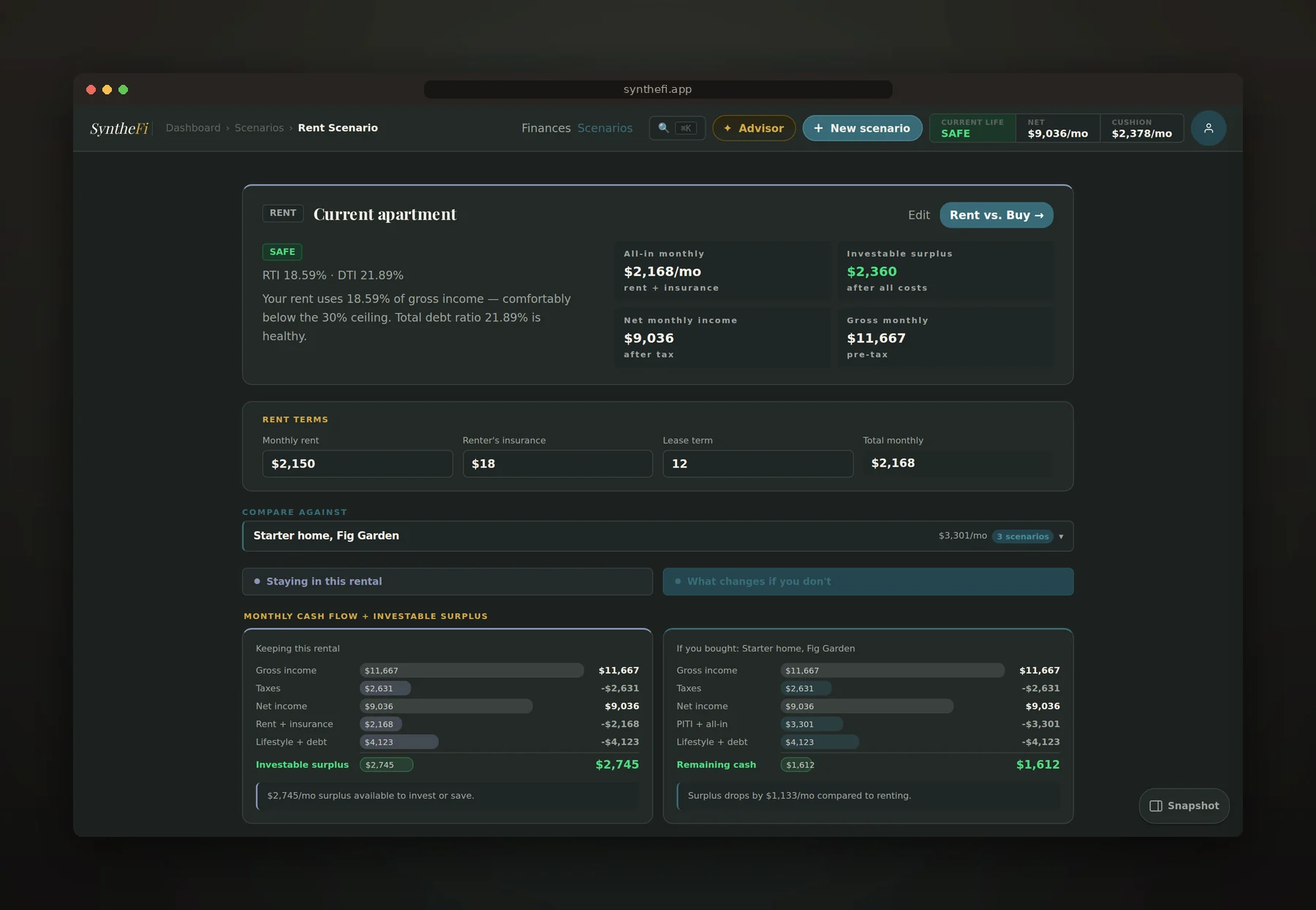
Renting gets its own verdict, a cash-flow breakdown, an emergency-fund check, and lease-end options: renew, move somewhere cheaper, or buy.
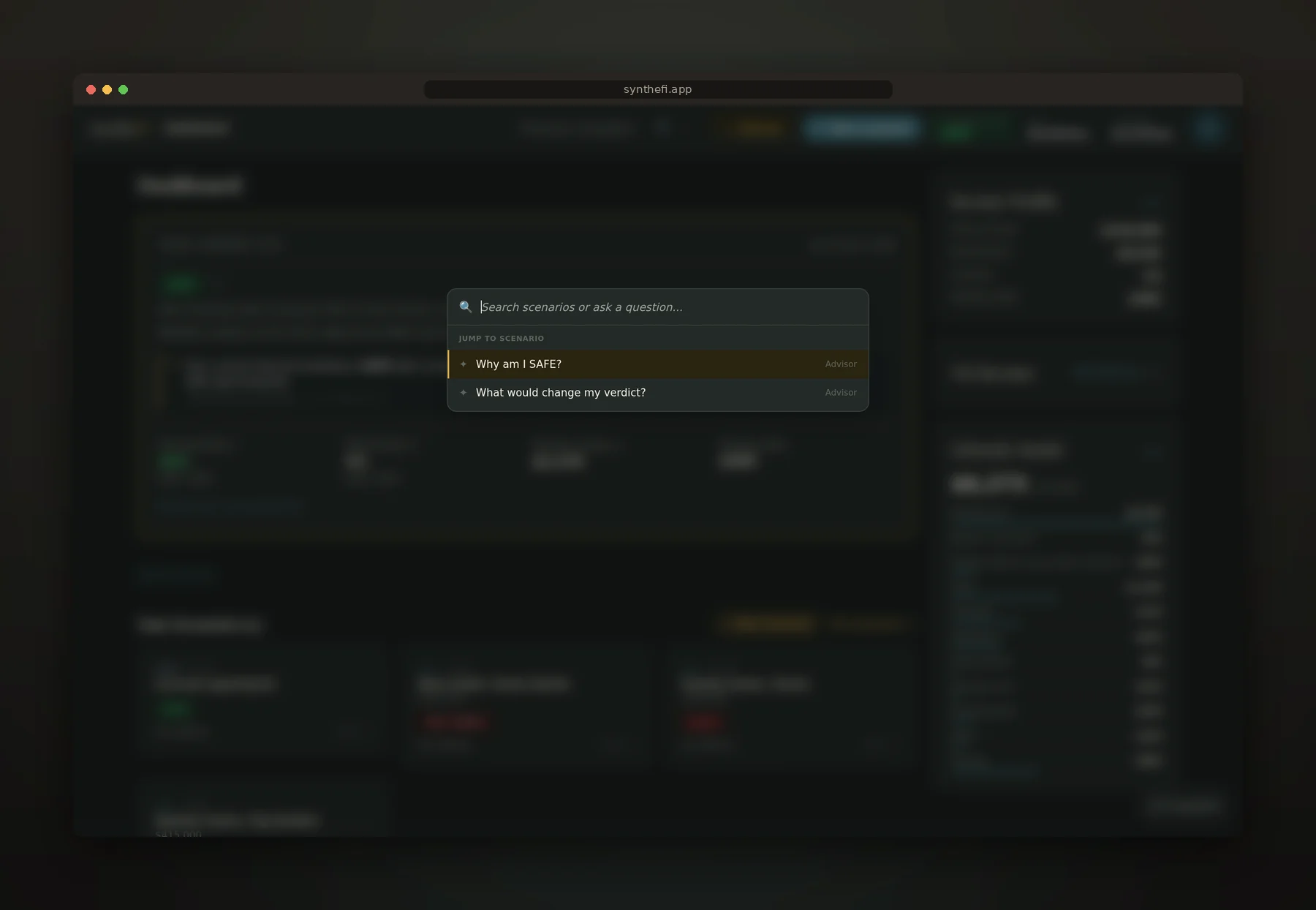
An AI advisor grounded in real numbers
A built-in advisor, powered by Claude, answers questions like "why am I Safe?" or "what would change my verdict?". It doesn't guess: it calls nine of SyntheFi's own calculation and lookup tools, knows which page the user is on, and must cite a source for every figure. The same pipeline writes short suggestion cards across onboarding, finances and scenarios, with the numbers computed first and AI used only for the wording.
Onboarding in five steps
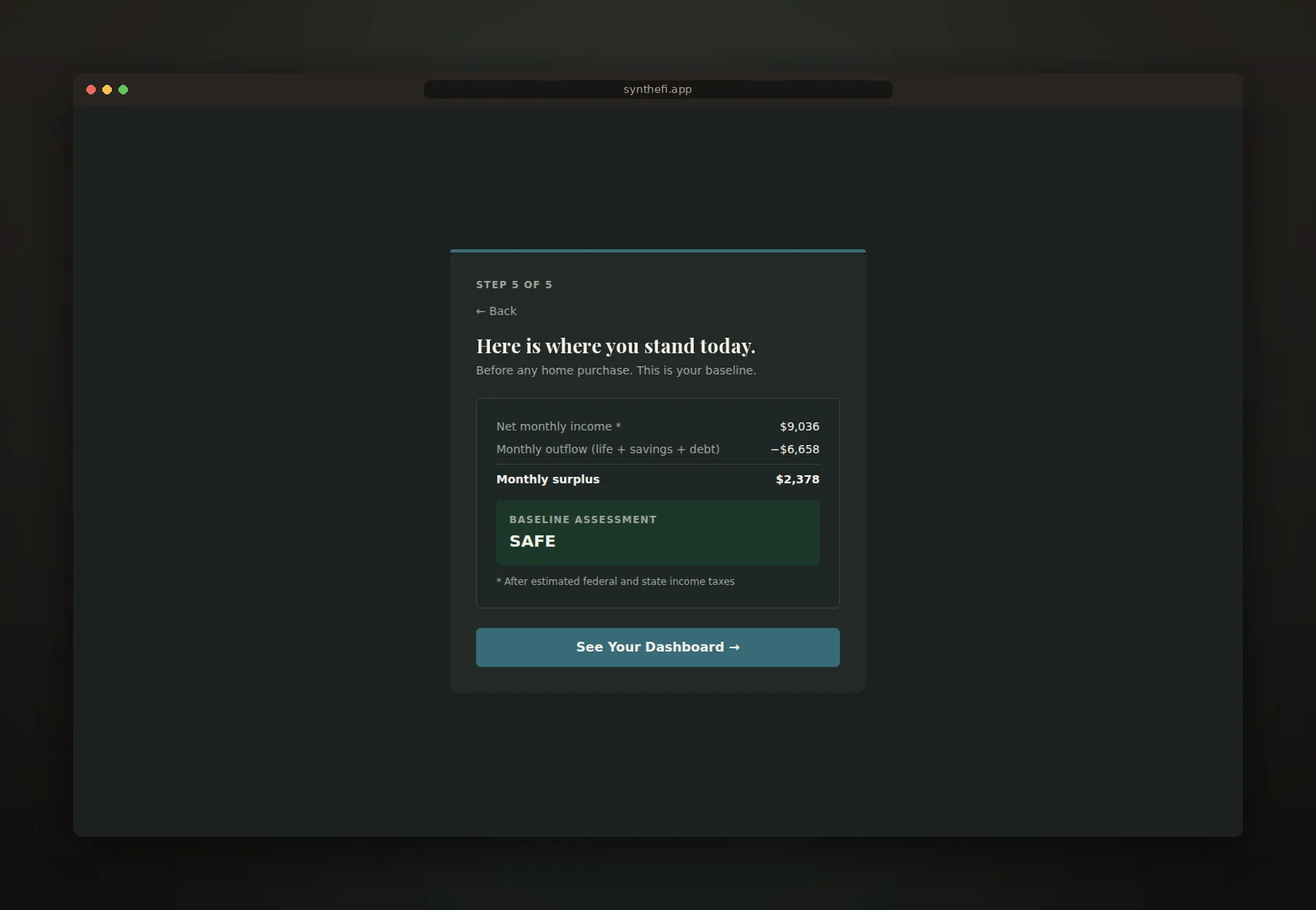
Income, location, household and spending, then a first verdict on current life, all before creating an account.
Built around the household
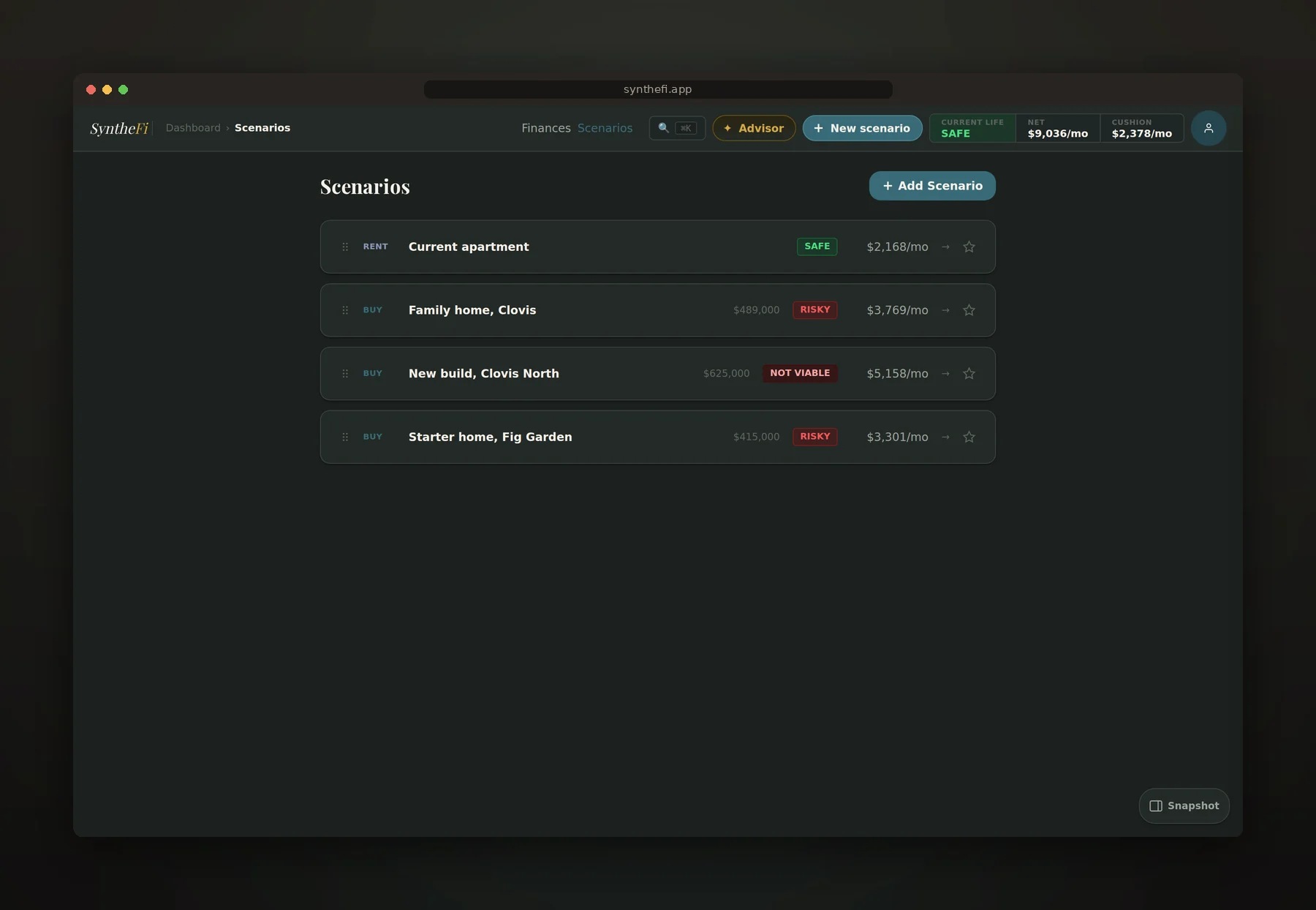
Multiple income sources and debts, scenarios pinned to the dashboard and reordered by drag and drop, a quick search to jump anywhere, and a live status bar with the current verdict and monthly cushion.
A full report for every home
The true all-in monthly cost including the repair reserve most buyers forget, a 30-year amortization with equity milestones, whether you can still afford it as taxes and insurance rise, repair-reserve adequacy for that price range, rate-lock value and refinance break-even, and a 10-year comparison against renting.
Accounts, plans and privacy controls
Sign in with Google, a one-time email link or a password checked against known breaches. Paid plans through secure checkout, and users can export all their data or delete their account at any time.
Inside a home report. Every home gets the same in-depth analysis. These are the sections of one report, for a made-up household of three in Clovis looking at a $489,000 home.
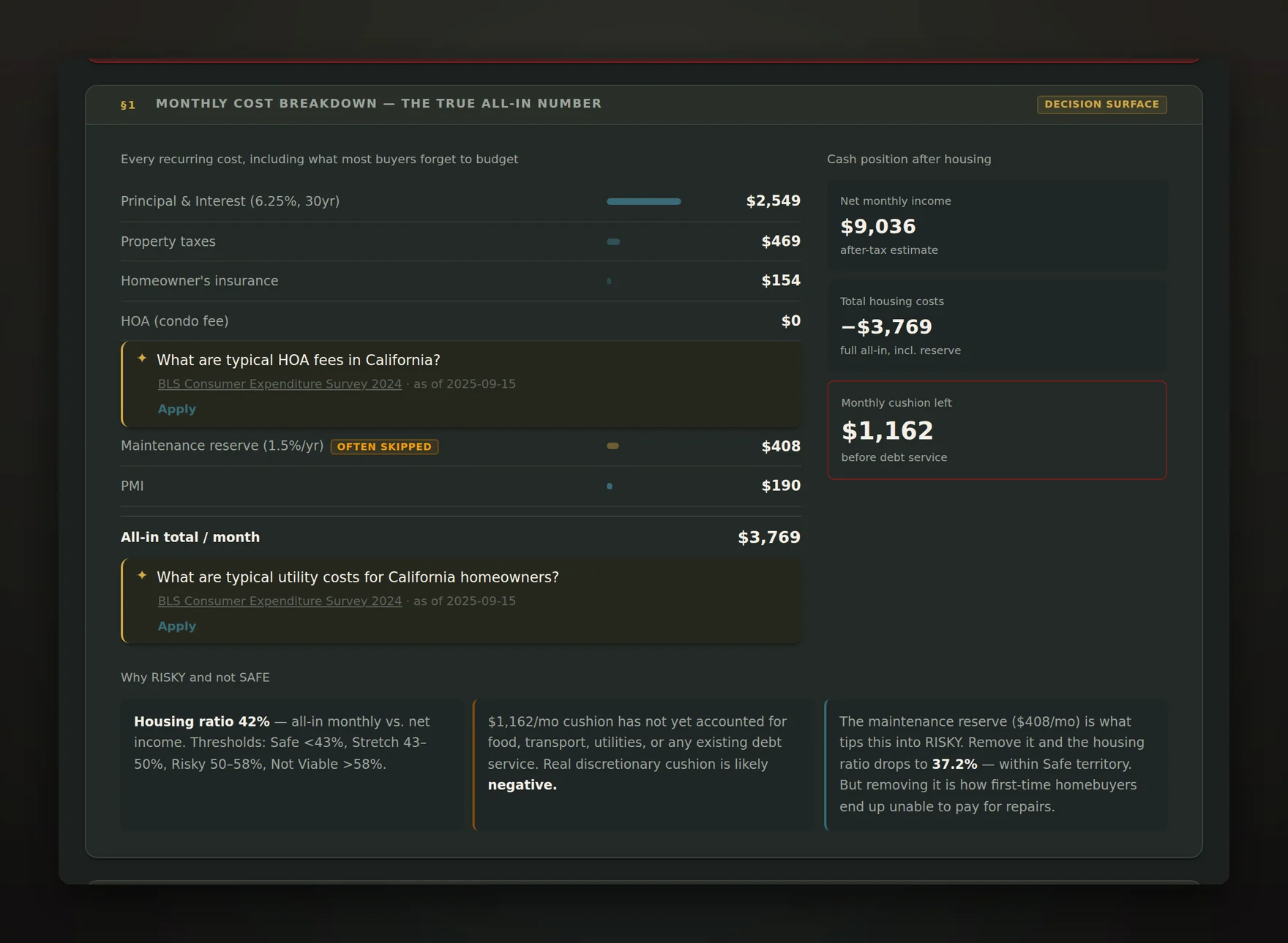
The true all-in monthly cost
Every recurring cost, including the repair reserve most buyers forget, against take-home pay, with a plain explanation of why the verdict landed where it did.
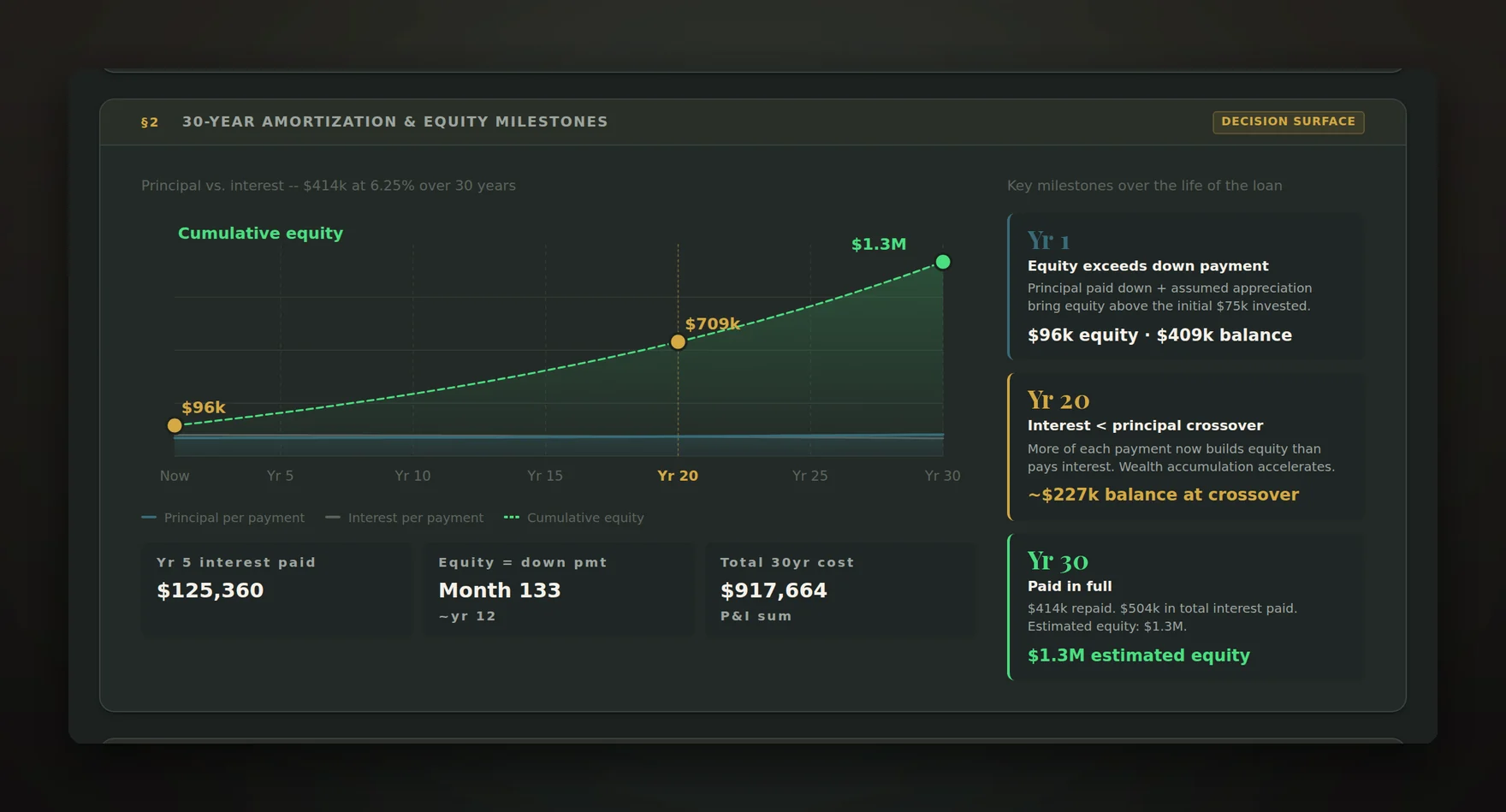
30-year amortization and equity milestones
Equity growth over the life of the loan, the year interest stops outweighing principal, and what the loan really costs in total.
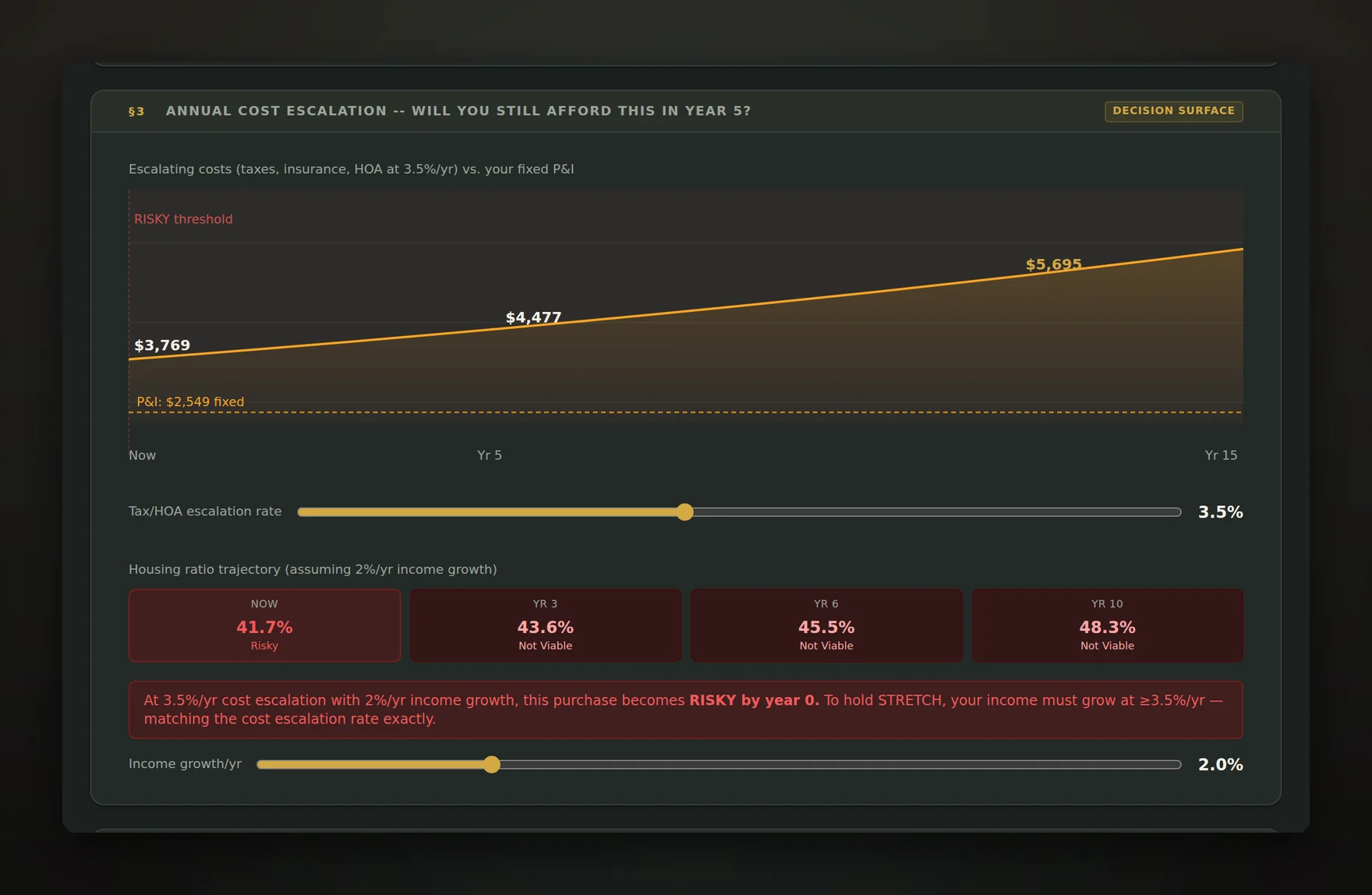
Will you still afford it in year five?
Taxes, insurance and HOA rise; the mortgage doesn't. Adjustable cost and income growth show how the verdict shifts over 15 years.
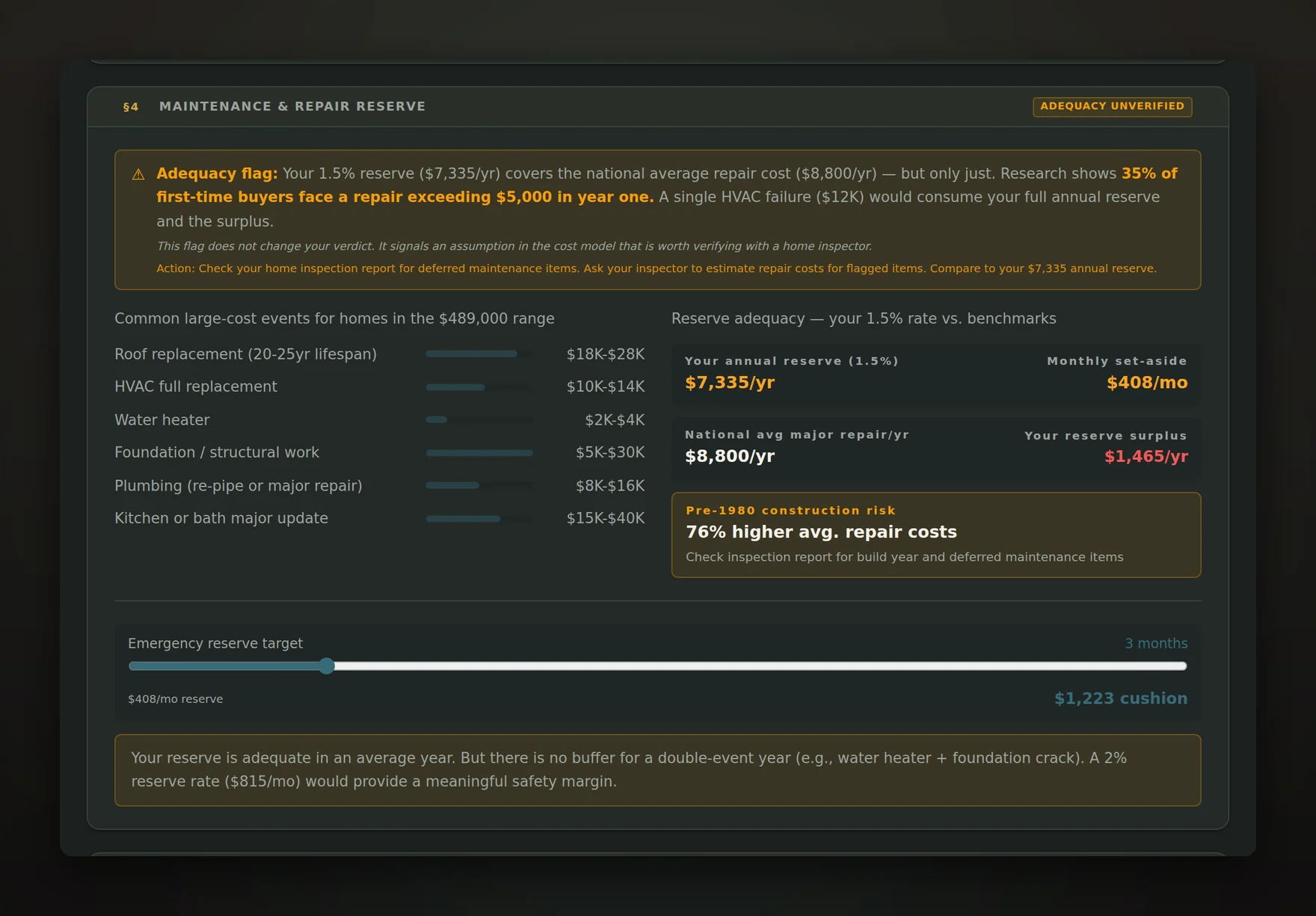
Is the repair reserve enough?
Typical big-ticket repairs for homes in that price range, the household's reserve against national averages, and an emergency cushion target.
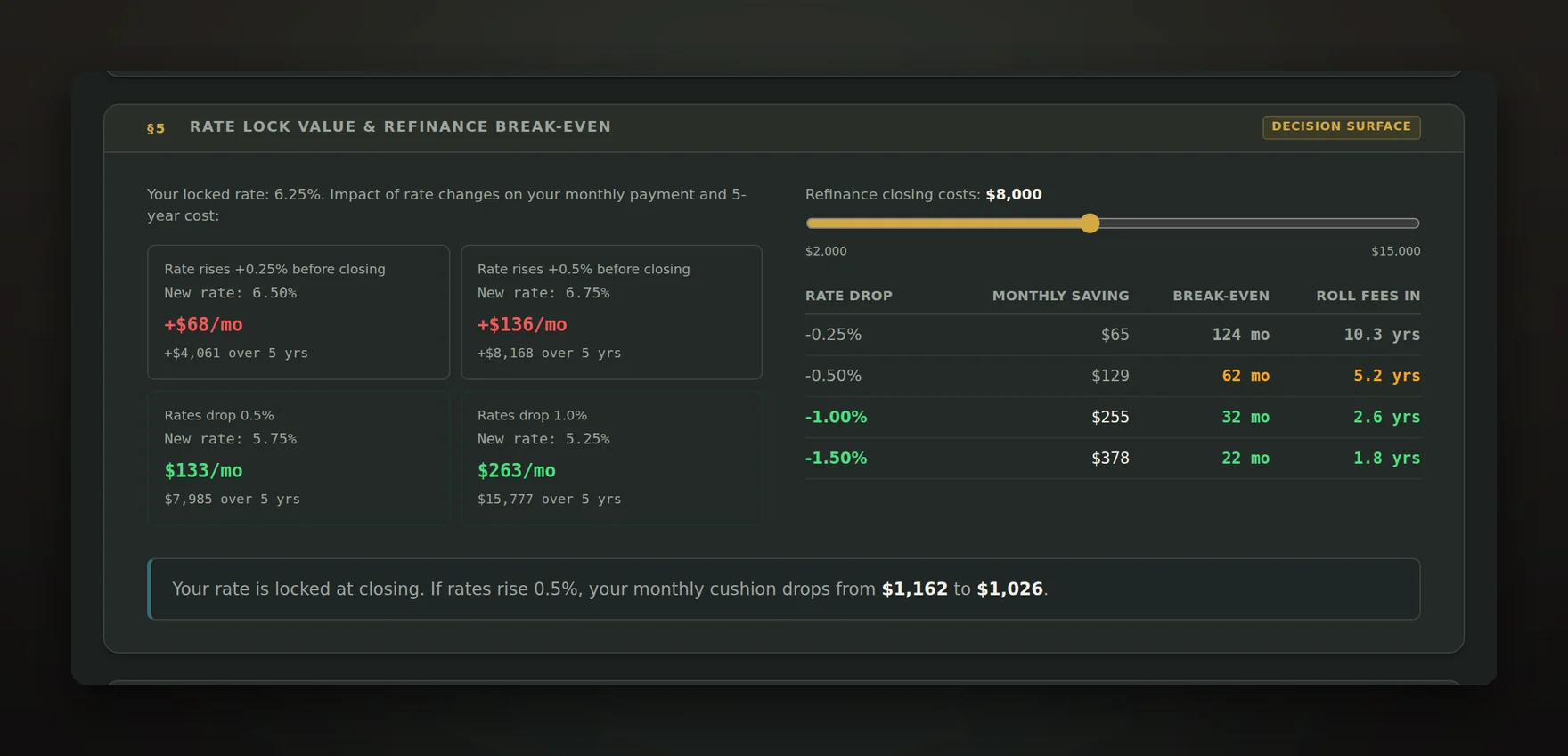
Rate lock value and refinance break-even
What a rate change before closing would cost, and how many months a refinance takes to pay for itself at different rate drops.
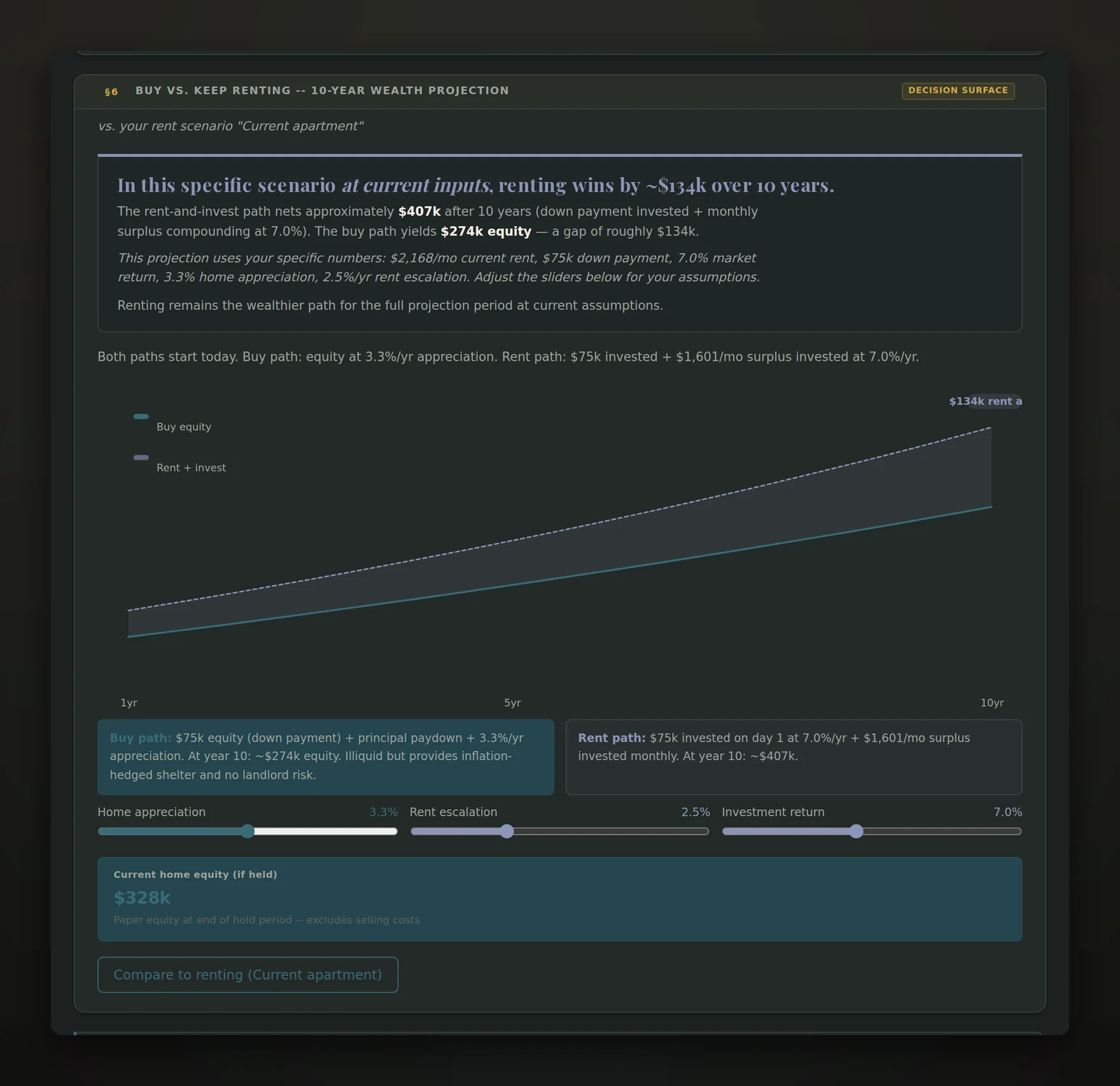
Buy versus keep renting
A 10-year wealth projection for owning against renting and investing the difference, with adjustable appreciation, rent growth and investment return.
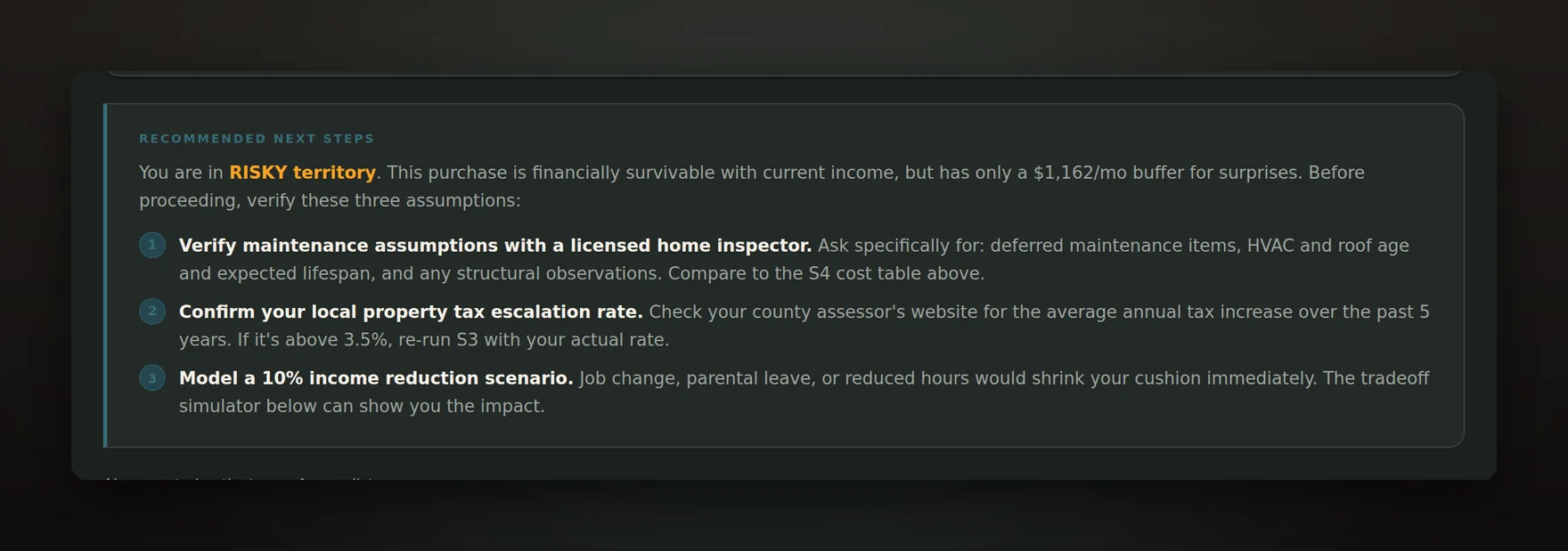
Recommended next steps
Specific things to verify before going ahead, tied back to the sections of the report.
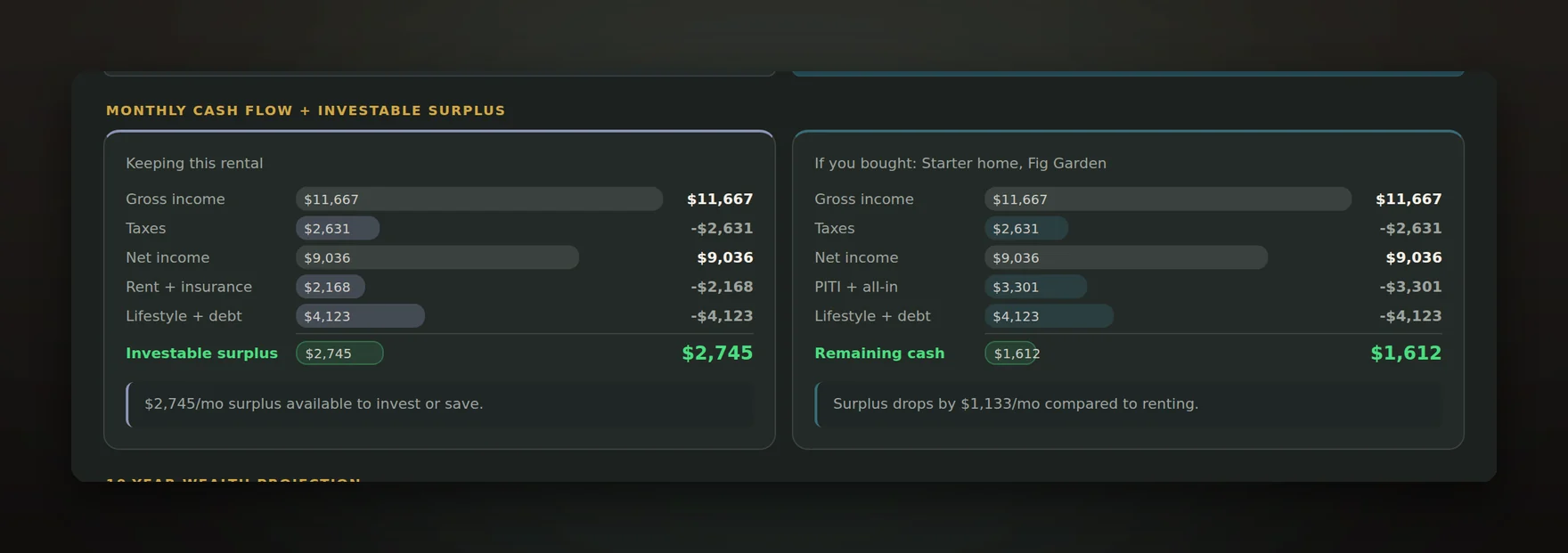
Renting: cash flow side by side
For renters, a monthly cash-flow comparison of staying put against buying, down to what's left to invest.
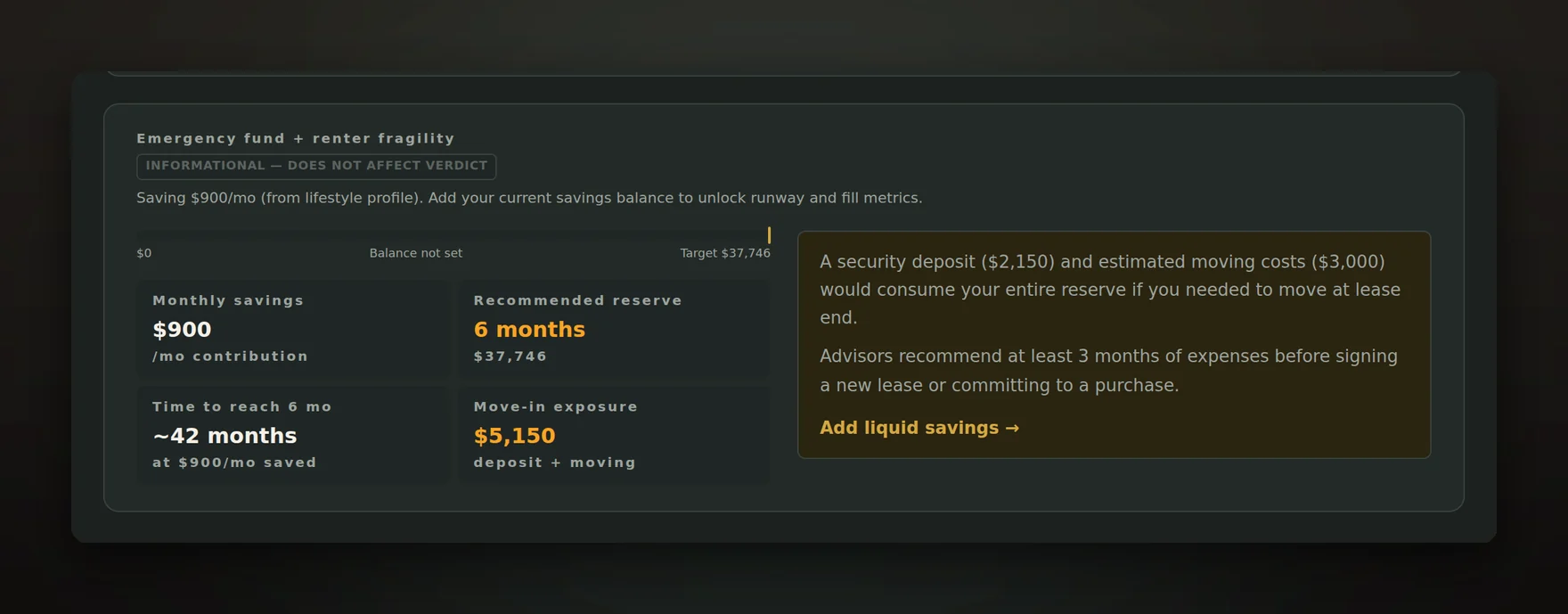
Renting: emergency fund and move-in exposure
How long it takes to reach a safe reserve, and what a deposit and move would cost if the lease ended tomorrow.
What it connects to. Each connection replaces a manual step or a guess with something the system handles itself.
U.S. Census data
Median home values and rents by ZIP code, refreshed nightly
HUD fair market rents
Local rent baselines, refreshed nightly
BEA regional prices
Cost-of-living adjustment by region, refreshed nightly
EIA energy data
Typical utility costs by state, refreshed nightly
BLS spending and CPI
Spending baselines by income bracket, adjusted for inflation
County property tax
Rates for about 3,200 U.S. counties
Anthropic Claude
The advisor and suggestion cards, through an AI gateway with tool calling and prompt caching
Stripe
Checkout, subscriptions, billing portal and verified webhooks
Google sign-in
One-tap login alongside email links and passwords
Breached-password check
Rejects passwords that appear in known data breaches
Transactional email
Verification, sign-in links, resets and admin alerts
PostgreSQL
Profiles, scenarios and history
Redis cache
Instant simulator results, rate limits and usage ceilings
How it's built.
- The financial rules live in six separate domains (profile, scenarios, verdicts, local benchmarks, accounts and history), with automated architecture tests that stop the rest of the code reaching into them.
- More than 4,000 automated tests, including about 475 end-to-end browser tests, cover the calculations, data and interface.
- Simulator sliders recalculate the verdict in under 200 milliseconds end to end, with a browser copy of the calculation kept in exact agreement with the server by tests.
- All money is stored in whole cents and rates in basis points, avoiding the rounding errors that creep into financial software.
- A nightly job refreshes the four government data sources when they go stale, and a missing ZIP falls back to county, metro and state data rather than failing.
- AI usage is metered and governed: per-plan monthly limits with a reminder at 80%, a site-wide daily spending ceiling that alerts an admin, the cost of every AI call logged, suggestion cards cached for 24 hours, and chat history kept for 30 days.
- Security is built in: strict browser security headers, rate limits on sign-up, resets and lookups, ownership checks on every request, sign-in tokens stored only as hashes, and "sign out everywhere".
- Next.js
- React
- TypeScript
- PostgreSQL
- Prisma
- Redis
- Claude (AI SDK)
- Stripe
- Auth.js
- Vercel
- Playwright
Next project
Halfmile Grove
Have something similar in mind?
If a process is slowing you down, your software doesn’t fit, or you have a new project in mind, we’d like to hear about it.